

Website · Documentation · Live demo · Releases · Discord
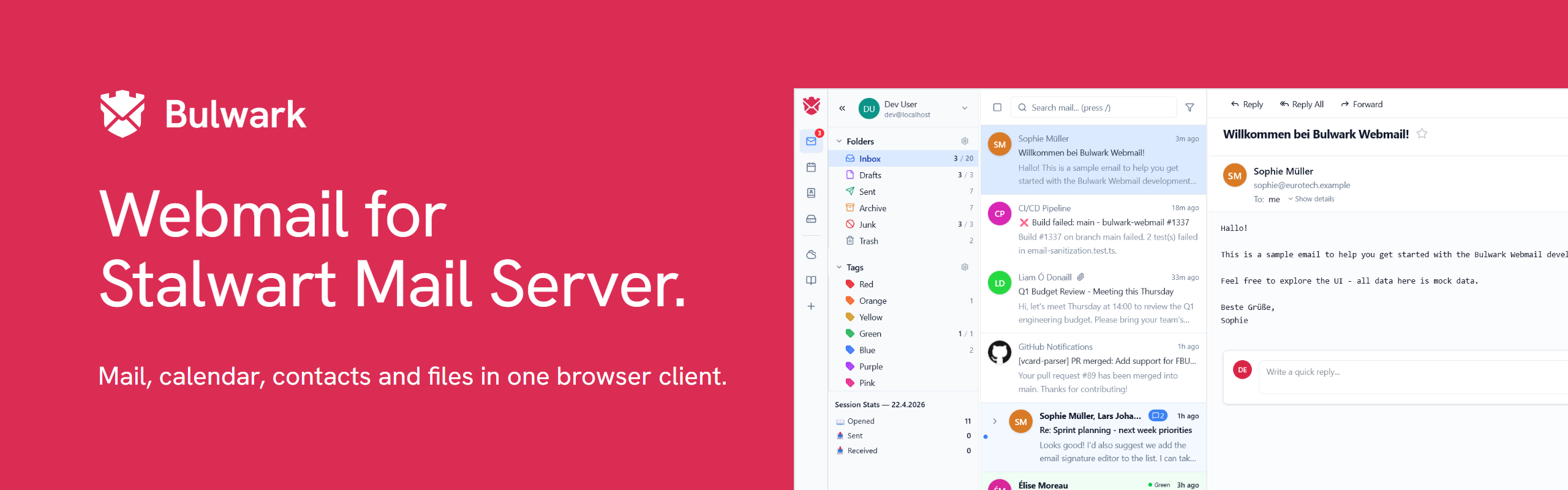
Bulwark Webmail is a self-hosted webmail client for Stalwart Mail Server. It talks to Stalwart over JMAP and puts mail, calendar, contacts and files behind one login, with one set of settings and one admin dashboard.

- Screenshots
- Features
- Quick start
- Other ways to install
- Configuration
- Documentation
- Development
- Community and support
- License


Calendar week view · Contact details with recent mail and upcoming events


Composer with identities and formatting · Light and dark themes
- Mail: threading, unified inbox, cross-account views, full-text search, Sieve filters, S/MIME, templates, scheduled send
- Calendar: month, week, day and agenda views, recurring events, iMIP invitations, CalDAV subscriptions
- Contacts: several address books, groups, vCard import and export
- Files: Stalwart's JMAP file storage, with previews, sharing and folder upload
All four share single sign-on and 2FA, multiple accounts, 27 languages, PWA install and web push, themes, plugins and keyboard shortcuts. The full list is on the All features page.
There are two editions. The full edition runs as a Node.js server and adds the admin dashboard, OAuth, plugins and settings sync. Bulwark Lite is the same client as static files, served by any web host or by Stalwart itself.
docker run -d -p 3000:3000 ghcr.io/bulwarkmail/webmail:latestThen open http://localhost:3000. A setup wizard asks for your Stalwart server and an admin password. The installation guide has the details, and Stalwart setup covers the mail server side.
| Method | Guide |
|---|---|
| Docker Compose | Compose |
| Behind a reverse proxy or on a sub-path | Reverse proxy |
| From source, without Docker | Manual install |
| Lite on any static host | Static hosting |
| Lite as a container | Container image |
| Lite served by Stalwart | Install on Stalwart |
Updating explains how to move to a new version.
Most installs are set up in the wizard on first launch and changed later in the admin dashboard. You can also use environment variables, which fit read-only or immutable deployments better. When both set the same key, the value saved in the admin config wins, so an environment variable only fills in what the admin config leaves unset.
JMAP_SERVER_URL=https://mail.example.com
APP_NAME=My Webmail| Topic | Guide |
|---|---|
| Overview, config files and precedence | Configuration |
| Every variable | Environment reference |
| OAuth2 / OIDC and single sign-on | Authentication, Embedded SSO |
| Several JMAP servers, custom endpoints | Multi-server deployments, Custom endpoints |
| Branding, logos, per-domain branding | Customization |
| Anonymous telemetry (off by default) | Anonymous usage stats |
All documentation is at bulwarkmail.org/docs:
- Getting started: Introduction, Installation, Editions, Bulwark Lite, Demo mode
- Deployment: Docker, Manual install, Static hosting, Install on Stalwart, Updating
- Guides: Admin dashboard, Account security, Impersonation, Plugins, Marketplace, Troubleshooting
- Extensions: Introduction, manifest.json, Publishing
- Development: Architecture, Contributing
- Legal: Privacy
The pages are Markdown files in the website repository. Send corrections there.
git clone https://github.com/bulwarkmail/webmail.git
cd webmail
npm install
cp .env.dev.example .env.local   # built-in mock JMAP server, no mail server needed
npm run dev
npm run typecheck
npm run lint
npx vitest run # unit tests
npm run test:integration # Stalwart in Docker + PlaywrightThe contributing guide covers tests, translations, code style and pull requests. Architecture explains how the code is organized.
The stack: Next.js 16 and React 19, TypeScript, Tailwind CSS v4, Zustand, Tiptap, next-intl, Tabler Icons, and our own JMAP client (RFC 8620). Tests run on Vitest and Playwright.
- Questions: check Troubleshooting, then ask on Discord.
- Bugs and feature requests: open a GitHub issue.
- Security vulnerabilities: report them privately to dev@bulwarkmail.org or through a security advisory, never in a public issue.
- Release notes: CHANGELOG.md and the GitHub releases.
GNU AGPL v3. This repository preserves the original MIT attribution for the fork lineage in NOTICE.
Thanks to root-fr/jmap-webmail and @ma2t for the groundwork this project builds upon.