



I'm a developer from Germany. By day I do quantitative research on prediction markets (mostly Polymarket microstructure and orderbook stuff). On the side I read a lot of open-source code and file the bugs I find, which is what most of the activity on this profile is about.
My path was not the standard "CS undergrad straight into a SWE job" one:
- Three-year vocational programme in business IT (German qualification: Kaufmännischer Assistent zur Informationsverarbeitung)
- Higher-education entrance qualification (German: Fachhochschulreife)
- Started a Bachelor in Informatics out of curiosity, dropped out without finishing because I learned more building real systems than working through the curriculum
I'm self-taught in everything that matters for what I do now. Reading unfamiliar codebases carefully is a big part of how I learn, and the contribution sprints on this profile are mostly that practice spilling outwards.
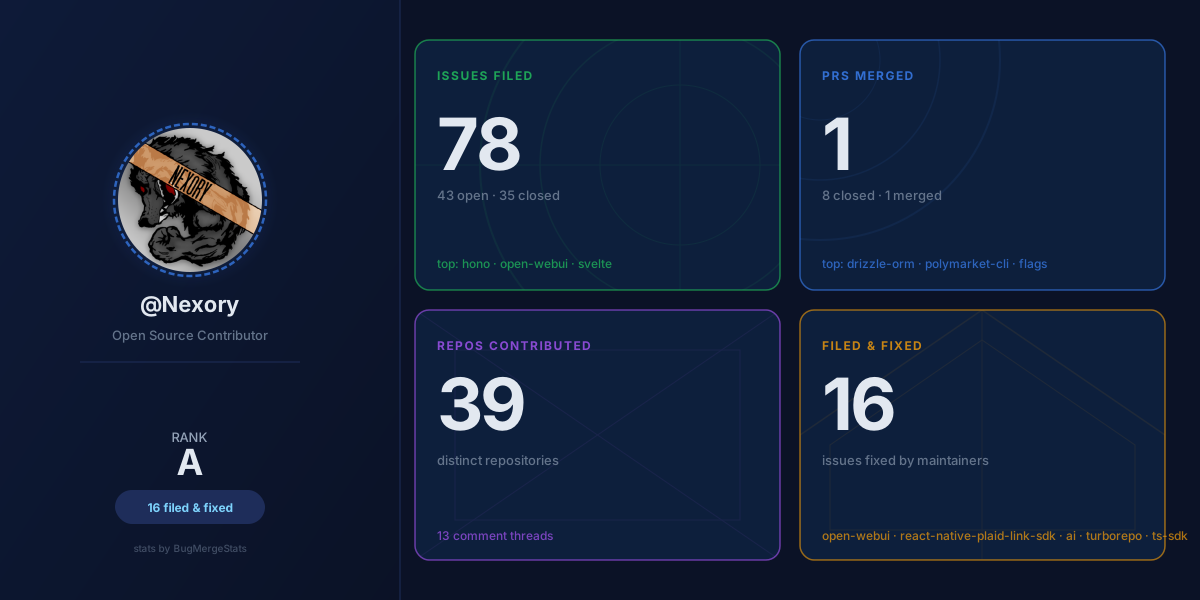
The card above counts what's actually visible: issues filed in public repos and PRs maintainers wrote to fix them. It undercounts on purpose, because a good part of the work never becomes a public artefact at all. Where a project asks for private reporting, the finding goes to that channel and stays there until they say otherwise.
The areas I keep coming back to:
- Memory safety in C parsers: image and archive formats, where a length field is trusted one line before it is validated. Box parsing in AVIF, TIFF and PNG decoders, cpio and bzip2 headers, filesystem tooling.
- Java deserialization and XML: JEP-290 filters on remember-me style cookies, XXE in transformers, class-resolution gaps in RPC layers.
- Crypto correctness: certificate serial numbers that come out negative half the time, TLS contexts that verify nothing because a parameter defaulted, timing-unsafe comparisons on secrets, S/MIME structures re-encoded before they are checked.
- Prototype pollution and injection in web frameworks: direct property writes that accept
__proto__, path segments that skip a denylist the sibling function applies. - PHP CMS and e-commerce: signature validation, upload paths, permission checks.
The rule I hold myself to is that nothing goes out that I have not reproduced first. In practice that means a test which fails without the fix for the right reason, passes with it, and both outputs written to disk rather than remembered. Then the full suite for regressions, and a run inside the project's own CI image where there is one, because "green on my machine" only proves my machine is tolerant.
I also try to be honest about the parts I did not measure. If exploitability rests on an assumption I could not test, that sentence goes into the report as an assumption, not as a finding. A report that overstates its own reach costs the maintainer more time than it saves.
Before anything is filed I check the project's own rules rather than my habits: where security reports are supposed to go, whether a CLA or DCO applies, whether the project even merges external contributions. Routing follows the written policy, not my read of the bug class.
Yes, I use Claude Opus for a lot of my issue and PR drafting and for the verification passes that run before I file anything. It's a tool I rely on the same way I rely on an IDE or a linter.
If you maintain a project I've reported on and you'd rather not receive AI-assisted reports, just say so on any of my issues or PRs and I'll stop on your repo. I'd rather lose a finding than burn a maintainer relationship over disclosure style.
I sign every commit with my SSH key (ED25519 SHA256:CWX60WPoOQcianliIELliGtEftFs9vEnkLmywphAUP8) and read everything I push. AI does the heavy code reading and drafting; the call to file and the responsibility for what gets filed are mine.
For coordinated disclosure, or if you maintain something I've reported on: the email address in the sidebar of this profile.
Sometimes useful for a maintainer who'd like to send a thank-you for a finding, or just if something here helped you.
| Chain | Address |
|---|---|
| ETH / EVM (Mainnet, Base, Arbitrum, Optimism, Polygon) | 0xc70d9CAbe1d11Edb126E6be7793D1E09cf5C7F89 |
| Solana | FqDxFXK21qsFamTrFgDAqYXd3L5MNshArf4RD2pbpTt |
| Bitcoin (native SegWit) | bc1qeepx83cenkjv29q0gvs8g74u7ujfexcgfsn9wc |